
Cameron County Supervision Paths
A person leaving Cameron County custody may enter one of three locally relevant systems. The Texas Board of Pardons and Paroles decides whether an eligible TDCJ prisoner may leave incarceration on parole or mandatory supervision. The TDCJ Parole Division then supervises that person. A Cameron County court imposes probation, formally called community supervision, and the Cameron County Community Supervision and Corrections Department administers it. Cameron Pre-Trial Services supervises some people released on bond before adjudication.
These labels cannot be exchanged. A person released on bond has not been paroled, placed on probation, acquitted, or discharged merely because the jail exit occurred. Likewise, a parole release confirms departure from prison but does not mean the sentence has ended. The person remains under legal custody and supervision until discharge.
Cameron County Parole and Probation Compared
The agency that issued the order determines which record can confirm supervision. This comparison keeps a Cameron court case separate from a TDCJ release.
| Feature | Parole | Probation |
|---|---|---|
| Who orders it | Texas Board of Pardons and Paroles after eligibility review | Cameron County court through its judgment or order |
| Who supervises it | TDCJ Parole Division | Cameron County CSCD |
| Custody before supervision | TDCJ prison | May replace or follow local confinement |
| Best first proof | BPP decision plus Parole Division status and dates | Signed Cameron judgment or community-supervision order |
| Public name search | TDCJ current-inmate search is limited; use status and records routes after release | No verified statewide probation-by-name search |
| End point | Parole or sentence discharge | Court or CSCD record showing supervision ended |
Mandatory supervision is also a TDCJ release category. For eligible modern cases it is discretionary, not an automatic calculation. BPP may deny it, and the Parole Division supervises an approved release. That makes its verification path closer to parole than to Cameron County probation.
Verify Cameron County Post-Release Supervision
Start with the last known custody and the legal event that followed it. A Cameron jail roster miss cannot identify parole, probation, or discharge because the roster has no release type or destination field.
- For a Cameron court case, read the signed judgment, probation order, bond order, or revocation entry through the proper District Clerk or County Clerk route.
- If the record shows a TDCJ commitment, use the TDCJ number or SID and review the official BPP decision. A favorable decision is not an exit timestamp.
- Call the BPP Offender Status Line at 844-512-0461 for state parole status. After a favorable vote, Review and Release Processing can be reached at 512-406-5202.
- For current parole or mandatory-supervision details, use TDCJ IVSS or request releasable information from the Parole Division.
- For probation, contact Cameron County CSCD through the official TDCJ Community Justice Assistance Division directory. CJAD regulates and funds local departments but does not supervise individuals itself.
- Confirm an actual jail exit with the Cameron booking-out record when the difference between release and transfer matters.
The broader Cameron County released-inmate search explains how court orders, IVSS events, and a Sheriff booking-out sheet work together. Use it when the supervision record alone does not reveal whether the person physically left Cameron County custody.
Cameron County Parole Review Milestones
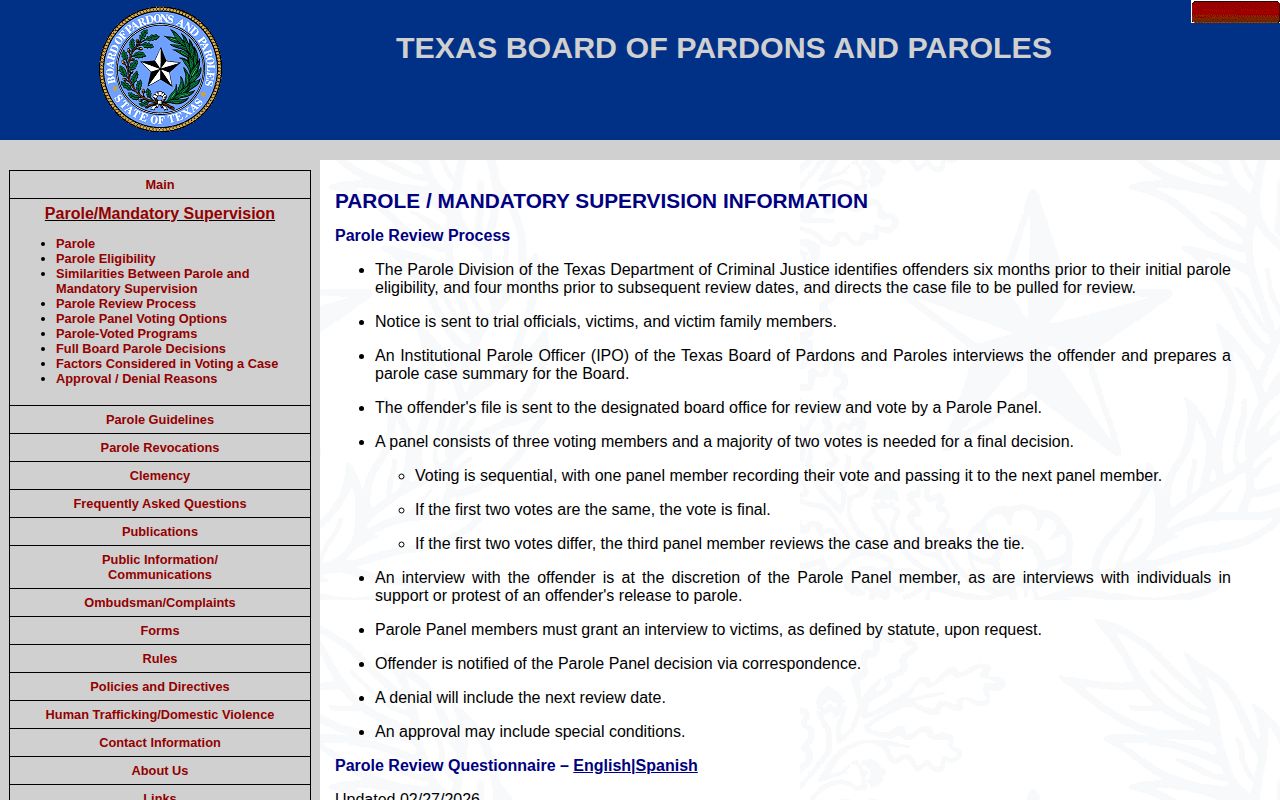
Texas parole review is a file process, not a routine public hearing calendar. Parole Division identifies initial cases before eligibility, an Institutional Parole Officer interviews the person and prepares a summary, and three panel members vote in sequence. Two matching votes decide the result. A denial sets another review date, often annually, although serious categories may receive a later date allowed by law.
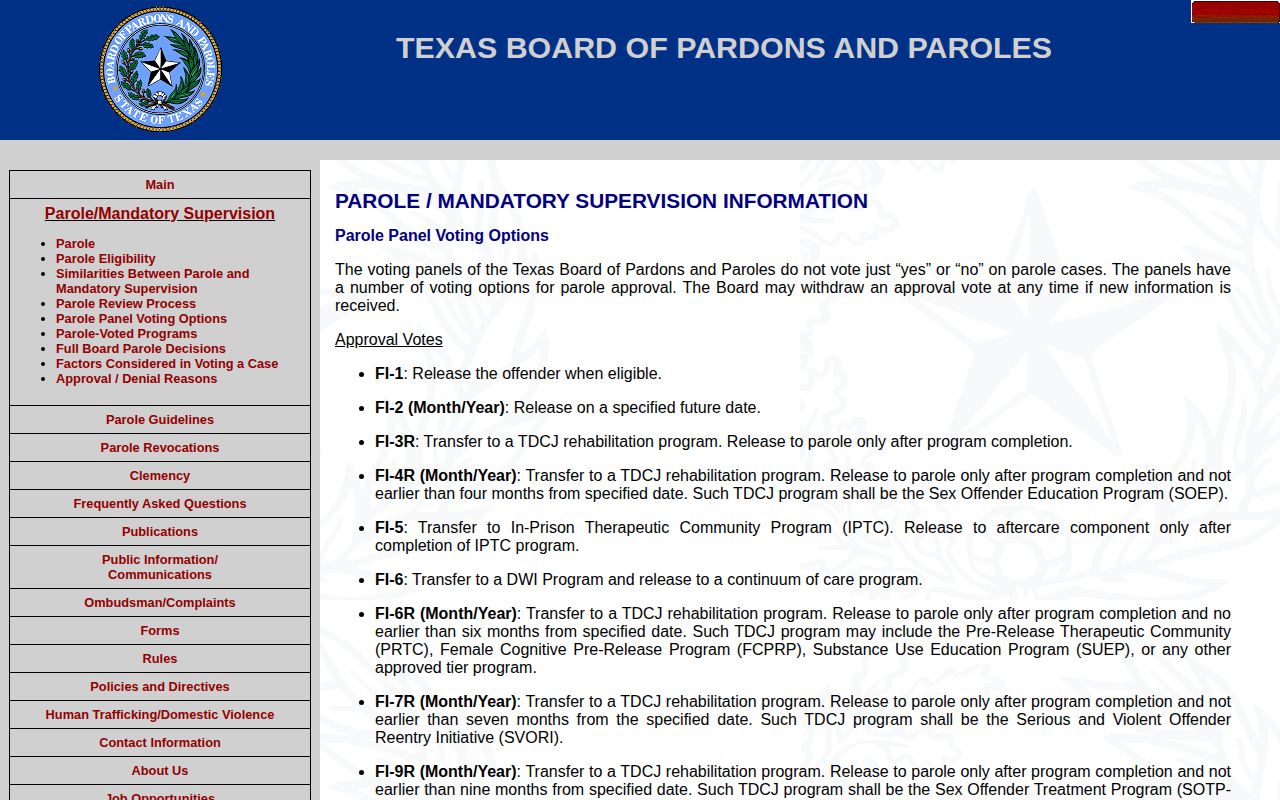
The code matters. FI-1 means release when eligible, while FI-2 points to a specified month and year. Other FI codes can require a treatment or program step. RMS means release to mandatory supervision. NR denies release and sets later review, and DMS denies mandatory supervision. None of these codes records an actual walk through the prison gate.
The official BPP review explanation shows the sequence used before a vote. The image below captures that state workflow.
After approval, TDCJ may still need an accepted residence plan, a required program, special conditions, a records audit, detainer resolution, and a release certificate. That processing gap is why a vote result and actual release date should never be reported as the same event.
Cameron County Parole Decision Records
A TDCJ current record may show the last parole decision and review status while the person remains incarcerated. Once that online row disappears, it is a weak historical route because the public search covers current TDCJ inmates only. TDCJ IVSS, the Offender Status Line, BPP correspondence, a release certificate, and a Parole Division request are stronger after release.
The official BPP vote-options page defines the decision codes used in a file review. This captured view helps decode FI, NR, RMS, and DMS without treating any code as proof of physical exit.
Parole Division policy lists status and dates, supervising officer, parole or mandatory-release date, discharge data, warrant information, offense and court data, and certain descriptors among releasable categories, subject to lawful redaction. Ask for a date-specific record. A person may have been released on parole, later had a warrant issued, and then returned to custody.
Cameron County Probation Record Route
No verified statewide public probation-by-name lookup exists. The durable starting point is the signed Cameron County judgment or community-supervision order. Felony district matters belong with the District Clerk; misdemeanor matters use the County Clerk and iDocket route. The order identifies whether probation was imposed, its term, and conditions reflected in the public file.
Cameron County supervision contacts
Community supervision: Find Cameron County CSCD through the TDCJ CJAD directory.
Pretrial supervision: Cameron County Pre-Trial Services, 974 East Harrison Street, second floor, Brownsville, TX. Phone: 956-574-8118. Email: PTSupervision@co.cameron.tx.us.
State parole status: BPP Offender Status Line, 844-512-0461.
A revocation filing, amended condition, or discharge entry may change the picture later. Read entries in date order and distinguish an allegation from a signed court result. Government Code Chapter 552 supplies the general Texas access framework, but privacy, victim, treatment, security, expunction, and nondisclosure rules can limit what is released.
Cameron County Bond Release Supervision
Cameron Pre-Trial Services serves releases ordered through local courts and may administer GPS, drug patch, or SCRAM conditions when a court orders them. This is supervision tied to a pending case. A bond entry authorizes release but does not prove that every hold cleared or that the person crossed the jail exit.
Does supervision prove the person was released? It may explain the legal arrangement, but the Sheriff booking-out timestamp or a completed county IVSS event is stronger proof of physical exit. A transfer disposition means custody continued elsewhere.
When the court order and custody record appear inconsistent, ask each custodian what its record establishes. The court can explain the authority and conditions. The Sheriff can provide the actual release time, release or transfer type, and destination if public.
Cameron County Supervision Warrants
No Cameron-specific public parole absconder list was verified. Do not infer a warrant or absconder status from a missed office visit, a rumor, or an empty public search. Parole Division releasable information can include warrant data. Probation warrants and revocation proceedings should be checked in the Cameron court record and confirmed with the responsible department.
Conditions and violations also differ by order. Parole can involve a residence plan, reporting, programs, and special conditions set through the state process. Probation and pretrial conditions come from the Cameron court. A reported violation begins a process; it is not the same as a final revocation decision.
Property After Cameron County Transfer
Cameron County’s property rules provide a practical clue about what happened after a jail exit. The Sheriff states that a trust-account balance is returned upon release or transfer. When a person transfers to another county, property and money travel with the transporting agency. For a TDCJ transfer, family has 30 days from the release or transfer date to collect property during the documented weekday window.
This distinction is useful because a transfer to TDCJ can lead to later parole review, while a community release may lead to pretrial supervision or probation. The Sheriff Jail Division provides the local property rules. Those rules do not identify the supervision status by themselves, but they help prevent a custodial transfer from being described as a return home.
When Cameron County Supervision Ends
Discharge is the key endpoint. For parole or mandatory supervision, request a TDCJ or Parole Division record showing the discharge date. For probation, use the Cameron court and CSCD record that shows successful completion, early termination, revocation, or another final result. A person leaving incarceration on parole is not discharged solely because the prison term ended.
Texas retention rules keep probation case records for at least the end of supervision plus three years, but retention does not guarantee that every detail is public. A lawful expunction or nondisclosure can change access. Ask for the narrow record needed to establish status and date, and verify the answer with the agency that supervised the case.