
No Cameron County 72-Hour Release Feed
Cameron County has no verified official rolling list of people released during the last 72 hours. Its public inmate roster describes people currently and within the prior seven days housed in specified categories. That wording may help locate a recent booking, but it does not identify a three-day release group. The page has no release date, reason, destination, or released label.
A person may leave one of the county jail buildings and still remain in custody. Transfers among Carrizales-Rucker, Ruben M. Torres, and the Old County Jail are internal moves within one Sheriff's jail system. Other transfers can lead to TDCJ, another county, USMS or BOP, or ICE. Only the release or transfer disposition resolves that ambiguity.
Check Cameron County's Last Three Days
The practical method is to assemble a 72-hour event set from government records rather than relabel the hybrid roster. Fix a start and end time, collect identifiers for likely bookings, and confirm each departure separately. Use the Cameron County 24-hour release process when the question is limited to today.
- Search the Cameron roster for exact names and save each matching booking number and SO number.
- Review IVSS-Counties for a Cameron custody event, first confirming the county or agency in the live interface.
- Call the proper jail component for a current status check, especially when a release may have occurred outside ordinary office hours.
- Check the signed court order and docket for bond, dismissal, judgment, time-served calculation, or commitment information.
- Submit one focused NextRequest request with the exact 72-hour range and ask for booking-out sheets or an event list containing the actual exit time and disposition.
- Follow any destination field into the correct receiving system rather than treating a transfer as freedom.
Note: A custody alert is useful evidence, but the booking-out record gives the durable timestamp and disposition.
Cameron County 72-Hour Record Fields
A true three-day release list would need fields that Cameron's public roster does not display. The comparison below separates what can be harvested from the web page from what must be obtained through Odyssey, a court record, direct confirmation, or a public-information request.
| Field | Where it can be confirmed |
|---|---|
| Name, booking number, SO number | Public roster while the row remains displayed. |
| Booking date and charges | Public roster, then the jail file and court docket for context. |
| Actual release date and time | Booking-out sheet or Odyssey custody record, not the roster. |
| Release type or reason | Jail disposition, authorizing order, bond record, or judgment. |
| Releasing facility | Underlying jail record because the public roster has no facility field. |
| Destination or receiving agency | Release or transfer sheet and, when needed, the receiving custodian. |
| Booking photograph | Public roster or a focused county records request. |
The roster also excludes federal prisoners and detainees. A three-day check covering a federal Cameron case may therefore require the Southern District docket, USMS contact, BOP locator, or a focused federal records request.
Weekend Cameron County Release Verification
A 72-hour span is useful around weekends because it keeps Friday, Saturday, and Sunday events within one inquiry. It does not change the meaning of the evidence. The county's every-two-hour roster refresh is a display cadence, not a promise about the speed of booking-out processing. No verified Cameron policy authorizes an assumed early release merely because a projected date falls on a weekend or holiday.
Start with the signed judicial event, such as a bond order, dismissal, sentence, or commitment. Then obtain the Sheriff's actual booking-out time. A court order authorizes action, while the jail record shows when that action was completed. If a relative needs immediate confirmation, use the phone for the relevant component and follow with a written record request.
For a search focused on one person rather than a three-day set, the Cameron County released-inmate search explains how county, state, federal, and immigration systems fit together.
Why Cameron's Seven-Day Display Misleads
The roster notice combines current custody with prior-seven-days-housed language and limits the described groups to people who have not been presented to court, await bail, or serve state or local sentences. It does not say that everyone released during those seven days appears. It also gives no way to distinguish a current row from a released row using a status field.
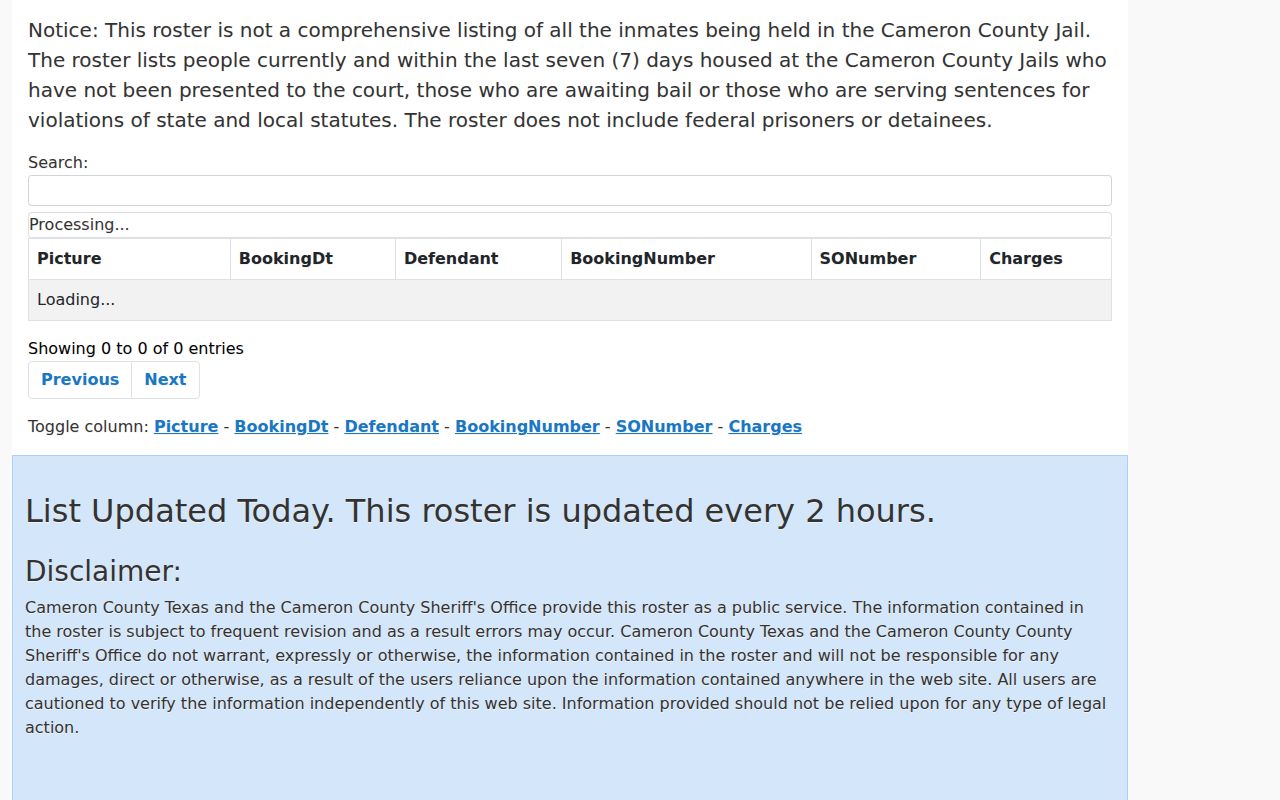
The web display should be treated as an identifier source. A screenshot from the official Cameron roster makes its notice and six public fields visible.
Nor is the web window the county's retention period. Texas Local Schedule PS keeps booking-in/out, release, transfer, and commitment records for at least two years after release or transfer. Disclosure still depends on the Public Information Act and applicable exceptions.
Build a Cameron County Three-Day Record
Use Cameron County NextRequest for the Sheriff's underlying records. State the inclusive date and time boundaries and identify whether the request seeks one person's booking-out sheet or records of completed releases and transfers in that span. For a named person, provide date of birth if known, booking number, SO number, and booking date. Ask for the actual exit date and time, disposition, releasing facility, destination agency if public, and authorizing order.
Texas Government Code Chapter 552 requires prompt handling but does not guarantee that responsive records arrive within ten business days. Within the applicable period, a governmental body may release records, provide a production date, report that none exist, seek an Attorney General ruling, or rely on a prior determination. Cameron publishes no verified special flat price for a release sheet, so costs should be confirmed through the live request process.
Trace Cameron County Transfers After Exit
A county release may return someone to the community on bond, complete a county term, or place the person under a court order. It may also end only Cameron County custody. A TDCJ commitment should be followed in the state inmate search after acceptance, though county-to-state processing can leave a gap. TDCJ's online tool covers current state prisoners, not a complete archive of discharged people.
If an immigration hold is plausible, use ICE ODLS. Port Isabel Service Processing Center is nearby, and a move there is a transfer into civil immigration detention, not a community release. ODLS may show current ICE custody and recent ICE exits, but “release” there can also mean removal or another transfer. For a sentenced federal person, BOP can retain a public released result after 1982. Pretrial USMS custody may not appear in BOP at all.
Read Cameron County Release Dispositions
A cash, surety, or personal bond permits physical exit while the case remains pending and may include Pre-Trial Services conditions. Time served or county sentence complete points to the signed judgment and jail time calculation. Dismissal, no-bill, or acquittal ends or resolves a particular prosecution but does not prove the absence of another hold. Probation is court-ordered community supervision, while parole follows a TDCJ prison release.
For every row in a reconstructed 72-hour set, record the destination alongside the time. That single field prevents the most common error: reporting disappearance from the Cameron roster as release to the public.
Keep the source date with each finding. Roster content can change at the next refresh, while a signed order and retained booking-out sheet remain the stronger historical evidence. When no responsive county record exists, document that result and check the relevant court or receiving agency instead of filling the gap with an inference.